This is a second group of Pontificals derived from – the now lost – ‘Mainz Original’ prototype.
One copy of the Mainz Original introduced significant changes. I call this pontifical ‘Mainz B’. Other pontificals used it as their exemplar.
Background: watering down of the diaconate
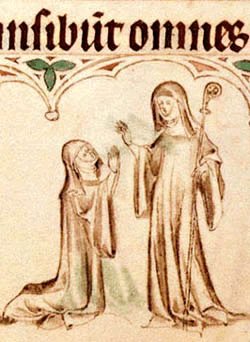
Abbess blessing a nun
(from queen mary psalter) Below left: new lady being welcomed to a convent.The early Middle Ages saw a deterioration of the diaconate ministry. For men this meant that the diaconate was now seen as purely a step to the sacrificial priesthood, a trend which only the Second Vatican Council reversed. For the diaconate of women, the situation was even worse. Their former involvement in the real apostolate: instructing female catechumens for baptism, assisting at their baptism itself, taking communion to the sick or administering their anointing, had now ben forgotten.
Theologians like Thomas Aquinas (1225-1274) were ignorant of what the original ministry of the woman deacon had meant. He writes in the context of whether women can receive ordination:
“Some, however, have asserted that the male sex is necessary for the lawfulness and not for the validity of the sacrament, because even in the Decretals (cap. Mulieres dist. 32; cap. Diaconissam, 27, qu. i) mention is made of deaconesses . . . But deaconess there denotes a woman who shares in some act of a deacon, namely who reads the homilies in the Church . . .” Summa Theologica Suppl. qu. 39 art. 1.
Prominent ladies at times entered religious life on their own terms. Hroswitha of Gandersheim (935-1002), for instance, entered the Benedictine abbey of Gandersheim as a canonness not as a nun. She took the vows of chastity and obedience, but not the vow of poverty. “She was allowed to receive guests, to come and go with permission, to own books, to own property, and was permitted to have servants, although she lived a communal life and shared the daily recitation of the Divine Office.” (Ann Lyon Haight,Hroswitha of Gandersheim: Her Life, Her Times, Her Works, p. 11) It is clear that she enjoyed an outstanding education and read the Latin classics as well as Christian authors.
Historians have – perhaps rightly – suggested that the diaconate for women in the early Middle Ages had become a status symbol, bestowed on women of noble descent who wanted to join a convent but could not become its abbess because someone else already held that position.
Making such ladies a ‘deaconess’ would give them a status of their own. (So F. Maasen, ‘Glossen des canonischen Rechts aus dem karolingischen Zeitalter’, Akademie der Wissenschaften vol 84, 1876, p. 274.)
Characteristics of ‘Mainz B’
The editor of the ‘Mainz B’ Pontifical, on which four manuscripts known to us (see below) depend, has significantly altered the ‘Mass to Consecrate a Woman Deacon’. He removed practically all features relating to the ancient deacon’s ministry:
- the ancient ordination prayer (Exaudi)
- the imposition of the diaconate stole
- the woman deacon’s receiving communion directly from the bishop, etc.
However, he maintained the first section he found in the Mainz Original, entitled ‘To make a deaconess’. He retained here both the rubric about the deacon’s stole and the ancient ordination prayer (Exaudi). Perhaps he was aware of the fact that this section, via the Hadrianum, derived from the Gregorian sacramentary that ‘should not be altered’.
The text of ‘Mainz B’
click on each pontifical to see its detailed text (Latin and English)

 |  |  |  |
|---|
A. Ancient Ordination Rite
| The word ‘diacona’ was ancient. Later the word ‘diaconissa’ (deaconness) became common. | |
|---|---|---|
| The stole originally indicated the full status of the diaconate. Whoever wore a diaconate stole without ordination was excommunicated (Synod of Laodicea 363 AD). | |
| The ordination prayer – EXAUDI – is the oldest part of the woman deacons’ rite of ordination. |
B. Mass for the ordination of a woman deacon – purged form
Many ancient ‘ordination’ elements have been purged from the formulary of this Mass: the ordination prayer EXAUDI, the ordination preface, the laying on of the diaconate stole and the woman deacon’s special role in communion. Only the ordination preface is still there, at least in substance. Omissions are noted against a purple background.
The whole Mass now focuses on ‘the vow of sexual abstinence’ required of the deacon. This makes it all the more curious to distinguish the mass from other masses (i) for the ordination of an abbess; (ii) for the consecration of virgins (“who decide to live a life of celibacy in their own homes”); (iii) for the consecration of a widow who has professed chastity; and (iv) for the consecration of a nun.
| ||
|---|---|---|
| ||
| The contents of this prayer focus on the support women deacons need in their commitment to sexual abstinence. | |
| ||
| ||
| In the old rite, the litany preceded the actual ordination. | |
| Instead of the ancient ordination prayer, a prayer for chastity is substituted which formerly was used when the woman deacon put on her veil. | |
| This is presented as ‘another’ ordination prayer. | |
| This ancient ordination preface is now interpreted as referring only to the woman deacon’s vow of sexual abstinence. | |
| The imposition of the diaconate stole has now been omitted. | |
| No imposition of the veil. | |
| a prayer omitted | |
| During the wedding ceremony husbands would give a ring to their brides, which perhaps also carried their seal. | |
| The meaning of ‘torquis’ here is not clear. In classical latin it denotes a clasp round the neck, or a chain hanging from the neck or a necklace. Here it seems to indicate a round quasi-crown on the head. | |
| Rubric about antiphon to be sung by bystanders is omitted. | |
| dedication prayer over woman deacon omitted | |
| ||
| the woman deacon’s offering a gift to the bishop is omitted | |
| ||
| This preface of the mass we only find in manuscripts copied from Mainz B | |
| ||
| ||
| ||
| ||
| Woman deacon’s receiving communion from the bishop in the sanctuary itself is omitted. |