Piecing together the ordination of women deacons as it must have been in the – now lost – sacramentary used by early bishops in Germany.
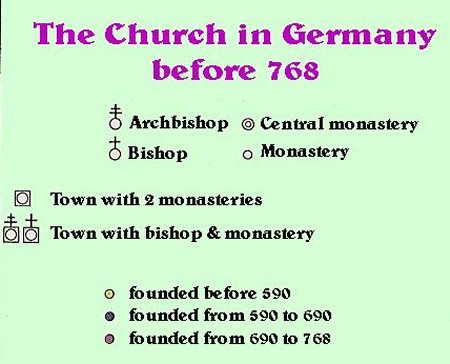
German lands were evangelised with the coming of Christian Roman soldiers. On the map, notice the dioceses (marked yellow or blue) that date from before 690 AD.
Indeed, there have been bishops from the earliest times. For instance, we know the names of at least 40 bishops who presided over the diocese of Mainz from 80 and 745 AD.
These bishops used sacramentaries for their liturgy. Some of these may have been related to the ancient sacramentaries of the first centuries. Others no doubt derived from the Proto-Gregorianum of ca 600 AD.
When St. Boniface was confirmed as Archbishop of Mainz in 745, he became metropolitan over all German dioceses. Mainz gained supreme influence, we can be sure, also in the realm of the liturgy. And women played a role. One of Boniface's close associates was the learned Lioba, abbess of Tauberbischofsheim (710-782).

The Church of the time was experiencing the period of the so-called Byzantine papacy (534-752). Many of the Popes hailed from Greece, Crete, Cyprus or Greek-speaking parts of Italy. A contemporary historian tells us that among the clergy at Rome there were seven Greek-speakers for every two Latin-speakers. The ordination of women deacons was a reality even in Rome at that time.
In 799 Pope Leo III had to flee Rome and sought refuge in Paderborn. When he returned later that year, he was welcomed back, we are told, "by the clergy, the senate, the army, and the whole population of Rome including nuns, deaconesses and noble ladies" (Vita Leonis III).
Reconstruction of prayers for women deacon's ordination
1. In the light of the above considerations, we may presume that a full, sacramental, ordination of the woman deacon was still presupposed in the 'German' sacramentary. The text of the consecratio (second ordination prayer/ ordination preface) will have focused explicitly and fully on the woman deacon's ministry.
2. At this time the general rubric about the stole must have been written down in the sacramentary. Since stoles are the vestment exclusively reserved to ordained deacons, this rubric confirms that the ordination was still treated as parallel to that of the male deacon.
3. The invitation prayer is now converted into a classic sequence of three blessings over the ordinand.
 |  |  |  |  |
|---|
 |  |  |  |
|---|
Ordination of a woman deaconas reconstructed from the 9 Pontificals listed above | ||
| Title |
| |
Stole rubric The general rubric concerns the stole. The term 'tunic' sounds strange here. It may be a translation from the Greek word 'maphorion' [=veil] that is used in the Byzantine ordination rite for women deacons. |
| |
Ordination prayer identical for men & women preserved in the Sacramentaries and Pontificals |
|
Consecration also known as second ordination prayer |
| |
|---|---|---|
i. The justification for ordaining women as deacons. Just as for male deacons the main model is the Levites who served in the Temple, for female deacons the main model is Anna who also served in the Temple. Women deacons are (a) to be prophetic [= instruct in the faith] and (b) anoint women with chrism. They fulfilled both functions at the baptism of women catechumens. |
| |
ii. This must have been part of the original consecration prayer, here reconstructed from the male ordination – missing in the Pontificals. |
| |
iii. Calling on God to make up for deficiencies in the candidate This part of the text is found in the Pontificals. |
| |
iv. Also this crucial part of the consecration preface for women deacons is now missing in the Pontificals. We reconstruct it here from the male parallel. |
| |
v. The concluding prayer for help in the Pontificals still contains references to her ministry among women. |
| |
Ordination Blessing
The ordination mass for women deacons contained these blessings on the women deacons before they received communion. These blessings run parallel in contents to the invitation prayer found in the ordination for male deacons. |
|