|
| |
| Sources: Monumenta Asiae Minoris Antiqua, vol. I – VIII, Manchester 1928 – 1962; Ute E. Eisen, Amsträgerinnen im fruhen Christentum, Vandenhoeck & Ruprecht, Göttingen 1996; Kyriaki Karidoyanes Fitzgerald, Women Deacons in the Orthodox Church, Holy Cross Orthodox Press, Brookline 1998; John Wijngaards, Women Deacons in the Early Church. Historical Texts and Contemporary Debates, Crossroad, New York 2002; Kevin Madigan and Caroloyn Osiek, Ordained Women in the Early Church: A Documentary History, Johns Hopkins University Press, Baltimore 2005. |
St Phoebe
| City or Province | Corinth, Greece |
| Time when she lived | 50-60 AD |
| Paul’s letter to the Romans 16,1-3 | “I commend to you Phoebe, the deacon [diakonos] of the church at Cenchreae, that you may receive her in the Lord as befits the saints and help her in whatever she may require from you, for she has been a helper of many and of myself as well.” |
| Feast Day in liturgical calendar | September 3 |
St Lydia
| City or Province | Thyatira |
| Time when she lived | 50-60 AD |
| Paul’s letter to the Romans 16, 14-15 | Lydia became Paul’s first convert at Philippi. She was baptized with her household, and Paul stayed at her home there.
She was reputed to have become a deacon. |
| Feast Day in liturgical calendar | August 3rd |
| Source | votary inscription in mosaic from Patras, Greece, early Byzantine period |
| Date | Early Byzantine period |
| Greek text | |
| Translation | “The deacon Agrippiane, most beloved, of God, made the mosaic in fulfillment of her vow.” |
Alexandra (of Thrace)
| Source | funerary inscription from Apollonia, a town in Thrace |
| Greek text | |
| Translation | “Alexandra subdeacon.” |
Athanasia (of Delphi)
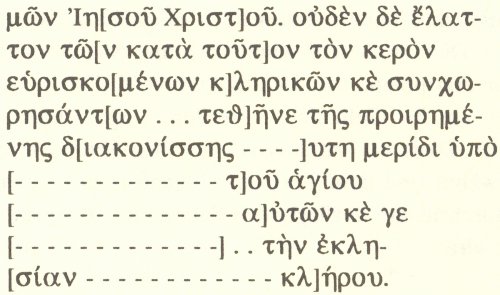
| Source | fifth-century tomb inscription from Delphi in Greece |
| Image | |
| Greek text | |
| Translation | “The devoted deaconess Athanasia, who lived a blameless life decorously, installed as deaconess by the most holy bishop Pantamianos, set up this memorial. Here He her mortal remains. If anyone else dares to open this monument where the deaconess has been placed, may he share the lot of Judas the [betrayer] of our Lord Jesus Christ. . .” |
Eirene
| Source | inscription, possibly dating to the fourth century, at the coastal town of Nea Ankhialos, near Volos, Thebes, in Thessaly |
| Greek text | [ KOIMHTHPION]
E]IPHNHC ΔIA
KONON KAI ZΩH
C THC ΔOYΛH
C MOY HN K[YPIOC]
ΠAPEΛABETO] |
| Translation | “[Burial place of] Eirene deacon and Zoe my slave whom the L[ord took up]” |
Eugenia (of Nicopolis)
| Source | carved marble monument from Nicopolis in Thrace |
| Date | dated June 12th, 538 AD |
| Greek text | +Eνθαδε κατκ[ιτε]
Eυγενια η της ευ[λαβους]
μνημης γεναμενη δ[ιακονισσα]
οκοδομησσα δομο[ν του]
ενδοξου αποστολου Α[νδρε]
ου κ(ε) εν σεμνη πολιτια [τε]
λεσασα τον βιον μ(ηνι) Ιουνιω βί ινδ(ικτιωνι) ά βα[σλι]
ας του θιοτ(ατου) κε
ευσεβ(εστατου η[μων]
δεσπο(του) Φλ(αβιου) Ιουστινιαν[ου]
του αιωνιου Αγ(ουστου)
κ[ε] Αυτοκρ[α]
τορος ετους βί υπατιας Φλ(αβιου)
Ιωαννου του λαμπρ(οτατου )+
|
| Translation | “Here lies Eugenia of praiseworthy memory, d (deacon). . . [stone broken off], who built the house (domo[n], i.e., shrine) of the glorious apostle Andrew in a holy manner, and ended life on June 12 in the first Indiction, in the reign of our godly and reverend ruler (despo[tou]) Flavius Justinianus, eternal Augustus and Emperor, in the twelfth year of the consulship (hypatia) of the noble Flavius John.” |
Unnamed deaconess (of Thasos in Thrace)
| Source | inscription on 5th-6th century tomb in Thasos |
| Greek text | “…ανή..ις + διακωνισ[σα] . . . “ |
| Translation | “. . . ane..is + deacones[s] . . .” |
Tetradia (of Thessaly)
| Source | marble plaque in the south end of the citadel of Volos in Thessaly |
| | |
| Greek text | KOIMHTHPION
TETPAΔIAC
ΔIAKONOY H
TIC AYTO AN
YΞI ΠAPEΞEM
OY ΔAΠANY
CI AYTON
ΠYPOC EΩ
NIOY ΔHKH
|
| Translation | “Tomb of Tetradia deacon. If anyone opens it except me, it will cost him the punishment of eternal fire.“ |
ACHAIA
Alexandria (of Elis)
| Source | fourth-century inscription at Elis in the Peloponnesus |
| Greek text | ENΘA[__________________]NOΓEN[__]
ET(ΩN)KГ ΘYГA[_____________]ΔPIAΣ ΔIA[K]
ANAΘPEΨAMENH Σ[_________]AΛIΦΘIΣA[__]ΠO TOY EMOY
Π(AT)P(O)Σ EPENIANOY EN TOIΣ ΣΠAPΓ ANOIΣMOXΘΩ KAI
EYXEΣ EΛΠIΔI TOY YIГEMOY TAΦHNE ΩΣ ΔE O Θ(EO)Σ HΘE
ΛHΣEN THN OΔON TAYTHN ΠPO AYTHΣ EΠΛHPΩΣA INΔ IΔ ΣEΠTEMBPIOY
IГ
|
| Translation | “Here lies [————] only child, twenty-three years old daughter of [————] and Alexandria deacon, raised and taken in by my father Erenianos in swaddling clothes, in distress and pleas, buried in hope by me. As God wished, I fulfilled this path for her in the fourteenth Indiction, September 13.” |
Andromacha
| Source | sixth-century mosaic inscription on the left side of the main altar of the basilica of St. Leonidas, in Klauseios, Achaia |
| Greek text | ΠΟΛΤΗΡΟΣ Ο
ΕΥΛΒΕΣΤΑΤ[Ο]Σ
ΑΝΑ[ΓΝΩΣΤΗΣ] ΚΕ ΑΝΔΡΟ
ΜΑΧΑ Η ΘΕΟΦΙΛ[Ε]Σ
Τ[ΑΤΗ] ΔΙΑΚ ΥΠΕΡ ΕΥ
ΧΗΣ ΑΥΤΩΝ Ε
ΚΑΛΙΕΡΓΗΡΑΝ |
| Translation | “Polygeros the most reverend lector and Andromacha the most beloved deacon[ess] of God, because of their vow, beautified [the place].” |
Nikagora
| Source | tomb in the monastery of Karea at Mount Hymettus, Athens |
| Greek text | |
| Translation | “I, Neikagorë deaconess, lie here“ |
MACEDONIA
Agathe
| Source | inscription on a tomb near the fifth-century Christian basilica at Philippi in Macedonia |
| Greek text | |
| Translation | “[resting place] of Agathe deacon and John treasurer and linen-weaver“ |
Axia
| Literary source | Theodoret of Cyrrhus, Letter Patmos 48 (44) |
| Date | 423 – 451 AD |
| Place of Deacon | Cyrrhus (?) |
Sample text/quote
from source
| “To Axia, deacon.” |
Agathokleia
| Source | inscription from Edessa in Macedonia. |
| Date | Fifth to sixth century |
| Greek text | |
| Translation | “Memorial of Agathokleia, virgin and deacon.” |
Matrona (of Stobi)
| Source | inscription in a paved public area in Stobi, Macedonia . An exedra is a small public rest area with seats. |
| Date | 4th or 5th century |
| Greek text | |
| Translation | “In fulfilment of a vow, Matrona, the most reverend deaconess, paved the exedra.” |
Posidonia
| Source | marble stele, Philippi, Macedonia |
| Date | From fourth—fifth century |
| Greek text | |
| Translation | “Illustrious graves of Posidonia deacon[ess] and Pancharia, the least canoness.” |
Theodosia
| Source | tomb stone at the fifth-sixth-century monastery of Hagia Triada, in Edessa, Macedonia |
| Greek text | |
| Translation | “Memorial of Theodosia deacon and Aspilia and Agathokleia, virgins.” |
Theoprepia
| Source | Inscription from Bonitsa, Macedonia |
| Date | Late 4th century |
| Greek text |  |
| Translation | “Here lies the slave of the Lord, Theoprepia, perpetual virgin and deacon[ess?] of Christ, who has completed a life ascetic, zealous, and distinguished in the Lord God.” |
Moesia
Celerina (of Novae)
| Source | dedicatory inscription on the lower part of a marble column in the episcopal basilica of Svistov, ancient Novae |
| Date | Probably from the time of the reconstruction of the basilica under Justinian (527-565) |
| Greek text | |
| Translation | “Of Celerina deaconess“ |
GREEK ISLANDS
Agaliasis
| Source | family funerary inscription from the island of Melos in the Cyclades, Aegean Sea |
| Date | 4th century |
| Greek text | |
| Translation | “In the Lord: the presbyters worthy of every commemoration, Asclepis and Elpizon and Asklepiodotos and Agaliasis the deacon and Eutychia and Klaudiane, virgins, and Eutychia their mother lie here. Since this tomb is full, I adjure you by the angel located before it that no one dare bury anyone else here. Jesus Christ, help the one who writes this and his entire household.” |
St Xenia
| City or Province | Island of Kos |
| Time when she lived | 5th century |
Details from
biographies
| St. Xenia, ‘the Merciful’ Born in Rome as ‘Eusebia’, the only daughter of a senator, she refused to marry as her parents desired. She fled to Kos with two servants where she started a community for women. She adopted the name ‘Xenia’ locals had given her (= ‘stranger’). She ministered as a deacon. She proved a great teacher of the faith. |
| Feast Day in liturgical calendar | January 24 |