|
| |
| Sources: Monumenta Asiae Minoris Antiqua, vol. I – VIII, Manchester 1928 – 1962; Ute E. Eisen, Amsträgerinnen im fruhen Christentum, Vandenhoeck & Ruprecht, Göttingen 1996; Kyriaki Karidoyanes Fitzgerald, Women Deacons in the Orthodox Church, Holy Cross Orthodox Press, Brookline 1998; John Wijngaards, Women Deacons in the Early Church. Historical Texts and Contemporary Debates, Crossroad, New York 2002; Kevin Madigan and Caroloyn Osiek, Ordained Women in the Early Church: A Documentary History, Johns Hopkins University Press, Baltimore 2005. |
PALESTINE
Anastasia (of Palestine)
| Source | funerary inscription of the Byzantine period in Wadi Kilt, between Jerusalem and Jericho |
| Date | Early 6th century |
| Greek text | |
| Translation | “Here lies Anastasia deacon, in the month of February 27, in the 11th Indiction (= 11th year in a 15 year cycle).” |
Basilis
| Source | inscription on a stone with cross in the middle, near Amisos |
| Date | 6th century |
| Greek text | |
| Translation | “Basilis deacon, who died the third of March in the fifteenth Indiction (= 15th year in a 15 year cycle).” |
Manaris (of Gaza)
| Literary source | Mark the Deacon, Life of Porphyry, Bishop of Gaza (102) |
| Date | 395 AD |
| Place of Deacon | Gaza in Palestine |
Sample text/quote
from source
| “Then it happened in those days that the old lady came to her rest and went to the Lord. Then calling the girl, he sent for deacon Manaris, whose name means in Greek Photeine [= light].” |
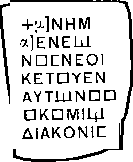
Eneon
| Source | fragmentary inscription above the entrance of a burial chamber in the village of Siloam, south of ancient Jerusalem |
| Date | |
| Image | |
| Greek text | |
| Translation | “. . . Tomb of Eneon, daughter of Neoiketes, deaconess in this hospital . . .“ |
Maria (of Moab)
| Source | inscription from Mahaiy, Moab, in present-day central Jordan |
| Date | Died 643-644 AD |
| Greek text | |
| Translation | “Here lies deacon[ess] Maria daughter of Valens who lived thirty-eight years and died in the year 538 [according to the Arabian calendar starting from Trajan’s establishment of the province in 105/106 = 643-44 AD.” |
Marthana
| Literary source | Egeria, Pilgrimage to the Holy Sepulchre (23.3) |
| Date | 400-417 AD |
| Place of Deacon | Jerusalem (?) |
Sample text/quote
from source
| “I found there a very dear friend of mine named Marthana, a holy deaconess (diaconissa) whom I had met in Jerusalem, where she had come to pray, to whose way of life all in the East bore testimony. She was governing (regebat) these monastic cells of apotactites or virgins (apotactitae virginum).” |
Severa (of Jerusalem)
| Literary source | Evagrius Ponticus, Letters (7.2, 8.2, 19.2, 20) |
| Date | 383-397 AD |
| Place of Deacon | Jerusalem |
Sample text/quote
from source
| “With regard to the chaste deacon Severa, I praise her intent but cannot accept the deed.” |
St. Syncletica (of Alexandria)
| Literary source | Corpus Scriptorum Ecclesiasticorum Latinorum, vol. X and XI, ed. J. Huemer, Vienna 1885, pp. 9-10. |
| Date | Died about 350 AD |
| Place of Deacon | Alexandria |
Sample text/quote
from source
| “Who would not wish and desire to be pleasing in the excellent judgment of Syncletica, sacred nun and deacon, who brought the dignity of her noble blood in such a way to glory through her humility that she deserved to be joined to the Senate of our heavenly homeland? (Her body) a worthy temple for the Lord to live in, brought under control by fasting, refreshed by prayer, utterly cleansed by chastity. Thirsting as she was, she drank the Scriptures of ecclesiastical teaching to such an extent that, if she had not lacked the permission of her gender, she could even have taught – although in the members of her female body her soul was masculine.” Caelius Sedulius (5th cent.), Letter to Macedonius |
Susanna
| Literary source | Acta Sanctorum [= The lives of the saints] |
| Date | 4th century AD ? |
| Place of Deacon | Eleutheropolis in Palestine |
Sample text/quote
from source
| “After all this, the thrice-holy bishop took holy Susanna and brought her to Eleutheropolis and put her at the head of a monastery of virgins, also making her a deacon of the holy church.” |
Nonna (of Palestine)
| Source | inscription from the west side of the Jordan River in the Byzantine province of Palaestina Tertia, the southernmost section of Palestine |
| Date | “Byzantine period” |
| Greek text | |
| Translation | “Here was placed the blessed Nonna deacon, the twenty-third of the month of Daisius, in the first Induction.” |
Sophia
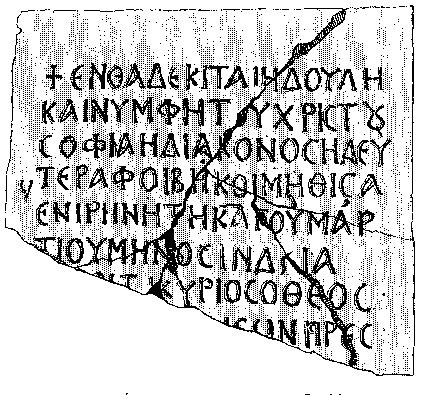
| Source | inscription on a broken stone on the Mount of Olives in Jerusalem. |
| Date | Probably 4th century |
| Image | |
| Greek text | |
| Translation | “Here lies the slave and bride of Christ Sophia, deacon, the second Phoebe, who slept in peace the twenty-first of the month of March in the eleventh Indiction . . . the Lord God . . .” |
Helladis
| Source | An iron coffin from the crypt of a Roman mausoleum at Um Qais (Gadara), now in the museum at Yarmouk University, Irbid, Jordan.
Museum inscription – “Helladis, a female Byzantine deaconess. she was a relatively low rank Christian clergy”.
|
| Date | ‘4th or 5th Century’ |
| Greek text | (No text available just yet) |
| Translation | |
EGYPT
St Apollonia
| City or Province | Alexandria |
| Date | Martyred in AD 249 |
Details from
biographies
| St. Apollonia A
holy
virgin
who suffered martyrdom
Alexandria
during a local uprising against the Christians previous to the persecution of Decius (end of 248, or beginning of 249). During the
festivities
commemorative of the first
millenary
of the Roman Empire, the agitation of the heathen populace rose to a great height, and when one of their poets
prophesied
a calamity, they committed bloody outrages on the Christians whom the
authorities
made no effort to protect. |
| Feast Day in liturgical calendar | February 9 |
Pentadia (of Egypt)
| Literary source | John Chrysostom Letters 94, 104, 185 |
| Date | 404-407AD |
| Place of Deacon | Egypt |
Sample text/quote
from source
| “To Pentadia, deaconess.” |
St Domnika
| City or Province | Alexandria |
| Date | Born 4th century |
Details from
biographies
| St. Domnika She lived in Alexandria in the late fourth century. In order to avoid a forced marriage she ran away from home. Patriarch Nektarios of Constantinople ordained her ‘to the priestly rank of the diaconate in Christ’. She set up a religious community of women and was involved in a ministry of teaching, but towards the end of her life she withdrew into a solitary life in the desert |
| Feast Day in liturgical calendar | January 8 |
Theodula
| Literary source | Life of St. Euphrasia |
| Date | 380-410 AD |
| Place of Deacon | Egypt |
Sample text/quote
from source
| “One day the deacon Theodula said to the girl kindly: Lady Eupraxia, do you love this monastery and the sisters?” |
Yemen
St Elizabeth of Najrân
Click here for more information
| Literary source | ‘The Martyrs of Najrân: New Documents’, by Shahid Irfan, Subsidia Hagiographica, 49, 1971.
The martyrs of Najrân were added to the Roman Martyrology in 16th century and commemorated on October 24th. |
| Date | First quarter of 6th century |
| Place of Deacon | Najrân, Yemen |
Sample text/quote
from source
| |