from a perspective of women in the Church
before Christ | During this century much of our modern civilization emerged.It was a time of lucrative colonial expansions by European countries such as Spain, Portugal, the Netherlands, France and Britain. This brought riches and new knowledge. A revolution occurred in science. Chemistry developed from medieval alchemy, and astronomy from superstitious astrology. Great scientists created new technology: Galileo Galilei (telescope, etc.) , Toricelli (barometer), Blaise Pascal (adding machine), Isaac Newton (spectometer), Anton van Leeuwenhoek (microscope), Christian Huygens (clocks) and so on. It led to the first conflicts between the Church and science. Well known is Galileo’s condemnation for proving the earth turns round the sun. Cardinal Bellarmine (1542-1621) played a major role in this. More amusing is the story that Pope Clement VIII (1592-1605) was urged to condemn coffee as Satanic, mainly because it was the favourite drink of Muslims. Fortunately he refused to do so. But Pope Urban VIII (1623-1644) issued a bull in 1624 that made smoking tobacco punishable by excommunication. Pope Benedict XIII later repealed the ban. Staying with Urban VIII, he fought wars to enlarge the Papal States. He fortified Castel Sant’ Angelo as a personal stronghold. He lived in great luxury and practised nepotism on a grand scale: various members of his family were enormously enriched by him, so that it seemed to contemporaries as if were establishing a Barberini dynasty. Among the cardinals he created were his brother Antonio Marcello Barberini and his nephews Antonio and Francesco Barberini. It was this Cardinal Francesco who acquired in 1650 the 8th-century-old manuscript (Barberini gr 336) which contains a copy of the ancient ordination rite for women deacons. |  from painting by Frans Hals |
|---|
|
|---|
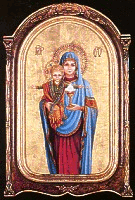 The theme of Mary’s priestly dignity
| d. 1610 | ‘Mary is a high priest, a bishop’ | |
| 1615 | ‘Mary, this sovereign pirestess’ | |
| d. 1628 | ‘Mary possessed the dignity of the priesthood’ | |
| d. 1637 | ‘Mary offers the Eucharist’ | |
| d. 1643 | ‘the eminence of the priesthood resides in Mary’ | |
| 1575 – 1646 | ‘Mary possessed the highest degree of the priesthood’ | |
| 1608 – 1657 | ‘Mary occupies the highest hierarchical rank in the priesthood’ | |
| 1585 – 1662 | ‘Mary possesses the fulness of the priestly spirit’ | |
| d. 1666 | ‘Jesus gave his mother a share in his priesthood’ | |
| d. 1671 | ‘Mary performed her task as high priest’ | |
| 1604 – 1675 | ‘Mary was ordained a spiritual priest’ | |
| 1599 – 1676 | ‘Mary shares in Christ’s sovereign priesthood’ | |
| d. 1676 | ‘Mary was a priestess’ | |
| d. 1692 | ‘Mary became Jesus’ priestess’ | |
| d. 1694 | ‘Mary sacrifices her son in the Eucharist’ | |
| 1608 – 1697 | ‘Mary h the episcopal dignity’ | |
| 1633 – 1715 | ‘Mary is the priestess of our religion’ |
The Women’s Quarrel 1600 – 1700
|
|---|
 The “Women’s Quarrel”, which started from the outrageous claim that ‘women are no
 more than animals’ (see previous century) raged all over Europe.In some universities the thesis was publicly debated. It became the topic of numerous tracts and books. It was used to tease women at parties and other social events. While some men launched their attack ‘tongue in cheek’, the discussion seriously embarassed many women and infuriated others. Many men resented women who gained power and prestige.
| 1618, reprinted 1619, 1671, 1673 . . . | “A thorough and documented description, argument and conclusion, together with extensive replies about the Question Whether Women are Human Beings?!”
|
|---|
|
|---|

| 1563-1636 | One of the first medically trained midwives. | **** | |
|---|---|---|---|
| 1585-1645 | Foundress of the Institute of the Blessed Virgin Mary | ***** | |
| ca 1600-1671 | Early American feminist and landowner. | ***** | |
| 1607-1701 | Novelist. | *** | |
| 1632-1664 | Poet and translator. | *** | |
| 1623-1673 | Prolific writer. | ** | |
| 1619-1677 | Composer. | ** | |
| 1614-1702 | “Mother of Quakerism” and author of “Women’s Speaking Justified”. | ***** | |
| 1664 | Decree by CharlesII | *** | |
| 1640-1689 | Professional playwright. | *** | |
| 1610-1696 | French still-life painter. | *** | |
| 1633-1699 | First professional female English painter | ***+ | |
| 1652-1706 | Spanish sculptress of the Baroque Era. | **** | |
| 1635-1719 | Foundress of Saint-Cyr-l’École, a school for poor girls of good families. | ** | |
| 1647-1717 | Traveller, naturalist and scientific illustrator. | **** | |
| 1666-1731 | English philosopher and writer. | **** |
The star rating indicates the importance for the vance of women |
|---|